Universe's First Rocky Planets May Have Formed Just 100 Million Years After Big Bang
Introduction
The cosmic timeline for planetary formation may need a significant revision. New research, based on sophisticated computer simulations, indicates that the universe’s very first rocky planets could have begun forming astonishingly early – potentially as little as 100 million years after the Big Bang. This groundbreaking finding challenges long-held assumptions about when the necessary ingredients for planet formation became available and suggests that the conditions for habitability might have existed far earlier in cosmic history than previously imagined.
Key Details
- Early Formation: Simulations suggest rocky planetesimals could have formed around 100 million years after the Big Bang.
- Stellar Debris: These early planets may have originated from the enriched debris of the universe’s first massive stars, specifically from pair-instability supernovae.
- Element Availability: These supernovae created pockets rich in heavy elements like iron and carbon, essential for forming rocky planets.
- Water Presence: The simulations also indicated the presence of water in these young stellar systems, with some planetesimals forming at distances conducive to liquid water.
- Potential for Ancient Worlds: If such early planetary systems exist, some could still be present today, potentially identifiable by their unique chemical composition.
Background
For decades, astronomers have sought to pinpoint the earliest epochs of planet formation. Traditionally, this quest involved understanding when sufficient quantities of heavy elements – the building blocks of rocky planets, such as carbon, oxygen, and iron – accumulated throughout the cosmos. Large-scale computer simulations have typically focused on the universe’s overall elemental enrichment over time. However, the research team, led by astronomer Daniel Whalen of the University of Portsmouth, took a different approach. They focused on the most element-rich environments in the early universe: the debris fields left behind by the explosive deaths of the universe’s first giant stars, known as supernovae. The hypothesis was that these localized areas, with their higher concentrations of heavy elements, might have provided the necessary conditions for planet formation much earlier than the general cosmic background would suggest.
Impact Analysis
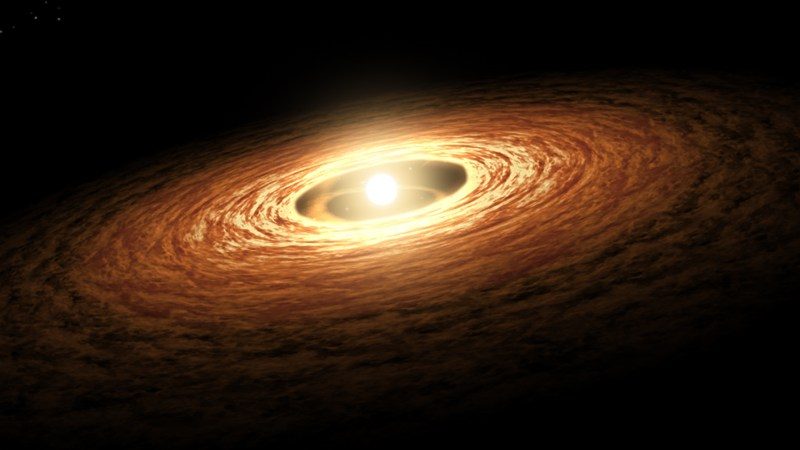
The simulations modeled the evolution of debris from a specific type of supernova called a pair-instability supernova. These cataclysmic events are capable of producing up to 100 times the mass of the Sun in heavy elements. The simulation results showed this debris mixing with the primordial gas of the early universe. Under the influence of gravity, this enriched material eventually collapsed to form new, small stars. Crucially, these nascent stars were surrounded by dusty disks, the very nurseries of planets. Within these disks, the simulations revealed the formation of planetesimals – small, rocky bodies ranging from meters to kilometers in size, considered the embryonic stage of planets. Remarkably, some of these planetesimals formed at orbital distances from their host star where temperatures would have allowed for the presence of liquid water, a key ingredient for life as we know it.
“Habitable worlds, in principle, could have formed billions of years earlier than previously thought, even before the first galaxies formed,” says astronomer Daniel Whalen, of Portsmouth University in England. “These simulations really go to the real true origin of life in the universe.”
Broader Context
The implications of this research extend beyond just the timing of planet formation. It fundamentally alters our understanding of when the potential for life could have emerged in the universe. Astrophysicist Jarrett Johnson of Los Alamos National Laboratory, who was not involved in the study, commented on the significance: “The study would indicate that all the way up back almost to the very beginning there may have been conditions for life being set in place. Just because there are planets forming doesn’t mean there’s life, of course, but the ingredients are being put in place pretty much as early as they possibly could be.” This suggests that the window for the origin and evolution of life might be significantly wider than previously considered, potentially spanning back to the universe’s infancy.
Future Outlook
The possibility that these ancient, potentially habitable worlds could still exist today is tantalizing. Whalen suggests that if such a system, formed around a long-lived star (the simulated star was about 70 percent the mass of the Sun), were to have migrated into our own Milky Way galaxy, it could be identifiable by its distinct chemical signature. The research team is already planning the next steps. They aim to simulate the subsequent growth stages of these planetesimals to determine the types of planets that ultimately form. Furthermore, they intend to investigate conditions around different types of supernovae that were likely more common in the early universe. These ongoing investigations promise to refine our understanding of early cosmic evolution and the prevalence of potentially habitable environments.
Conclusion
This pioneering simulation work by Daniel Whalen and his colleagues opens a new frontier in our understanding of the early universe. By demonstrating the potential for rocky planet formation within 100 million years of the Big Bang, fueled by the remnants of the first massive stars, the study significantly pushes back the timeline for the emergence of potentially habitable conditions. While the existence of such ancient planets remains to be confirmed observationally, the theoretical framework established by this research encourages astronomers to look deeper into the cosmic past and reconsider the earliest opportunities for the universe to foster worlds capable of supporting life.
Source: sciencenews.org