Sound Waves Power Tiny Robots: Helmholtz Resonance Revolutionizes Micro-Actuation
Introduction
In a remarkable feat of engineering, scientists have harnessed a century-old acoustic phenomenon to create miniature robots capable of flight, floating, and self-steering, all powered exclusively by sound waves. This groundbreaking approach bypasses the need for traditional motors and complex onboard electronics, offering a novel pathway for micro-scale actuation.
Key Details
- Helmholtz Resonance Principle: The technology is based on Helmholtz resonance, a principle first described by Hermann von Helmholtz in 1856. When air within a hollow cavity resonates at a specific frequency, it expels a jet of air, generating thrust.
- Miniaturization and Ultrasonic Frequencies: By miniaturizing these resonators using advanced 3D printing (two-photon printing), the required resonant frequencies are pushed into the ultrasonic range. This allows for precise focusing of sound waves without audible noise and avoids the potential annoyance or harm of loud, low-frequency sounds.
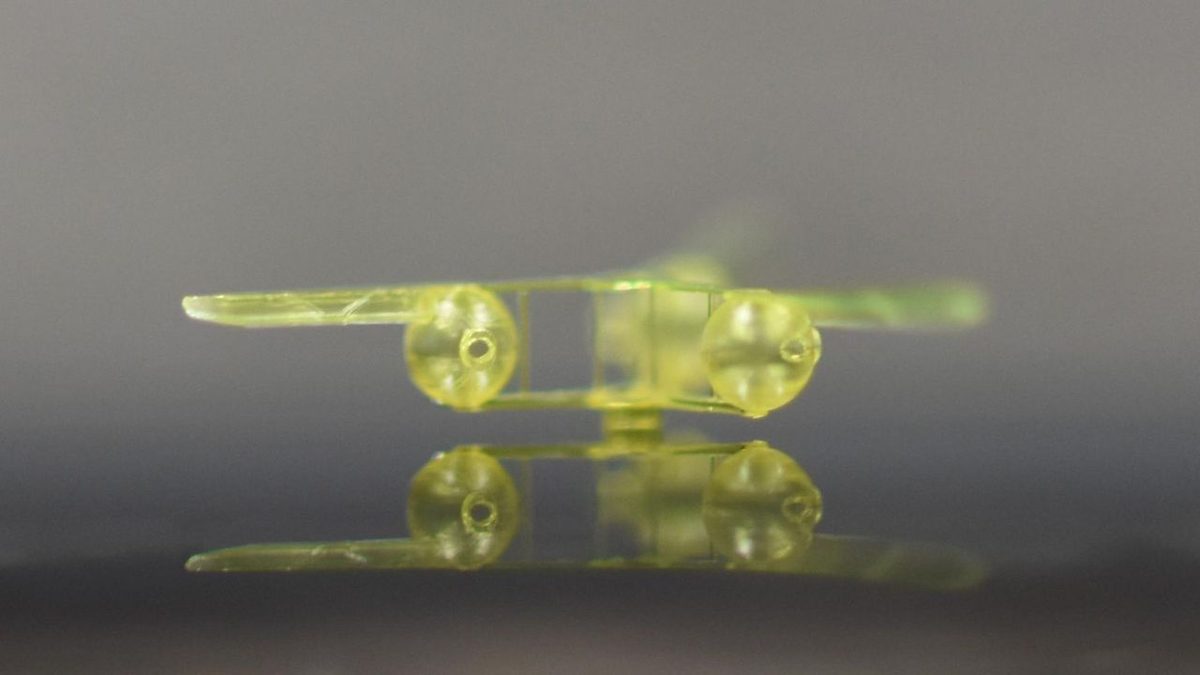
- Demonstrated Applications: Researchers successfully built and tested small boats (approx. 5 cm) that could be steered by altering the frequency of sound waves directed at multiple resonators. They also created microfliers (approx. 1 mm) that achieved lift either by expelling air like a rocket or by using sound to rotate tiny blades, mimicking a helicopter.
- Materials and Fabrication: The resonators are essentially precisely shaped hollow cavities, fabricated using advanced 3D printing techniques. This simple structure allows for extreme miniaturization.
- Publication: The findings were published on August 12 in the journal Science Advances (Hwang et al., 2026).
Background
The concept of Helmholtz resonance is familiar to anyone who has blown across the top of an empty bottle to produce a musical note. Hermann von Helmholtz, a 19th-century physicist, studied this effect in the context of developing tools for tuning musical instruments. He observed that resonating air within a cavity could produce a faint jet of air. While this effect is weak in musical instruments due to low pressure, the researchers realized that significantly increasing the pressure could amplify this jet into a usable source of force.
The key innovation lies in miniaturizing Helmholtz resonators. When scaled down to the millimeter or sub-millimeter level, the frequencies required to induce resonance shift into the ultrasonic spectrum. This is advantageous because ultrasonic waves can be precisely focused and are inaudible to humans, making them ideal for powering delicate micro-devices without causing disturbance.
Impact Analysis
This development represents a significant leap in micro-robotics and actuation. Conventional micro-motors face fundamental limitations in miniaturization due to the inherent complexity of their mechanical components, such as magnets, coils, and shafts. In contrast, these sound-wave-powered resonators are merely precisely shaped hollow spaces. This fundamental difference removes the physical constraints on how small these actuators can become, opening up possibilities for devices operating at scales previously unimaginable.
The ability to precisely control movement using focused sound waves offers a non-contact method for manipulation. This could be crucial for delicate tasks in sensitive environments, such as manipulating biological samples or assembling microscopic components.
Broader Context
The research builds upon decades of work in acoustics, fluid dynamics, and microfabrication. The repurposing of a principle from musical acoustics for advanced robotics highlights the interdisciplinary nature of modern scientific innovation. Furthermore, the development aligns with a broader trend in engineering towards creating more autonomous, adaptable, and minimally invasive systems, particularly in fields like medicine and environmental monitoring.
The use of sound waves as a power source also offers potential advantages in environments where electromagnetic interference is a concern, or where traditional power sources (like batteries) are impractical due to size or weight constraints.
Future Outlook
The researchers view this work as a foundational step. Future research will likely focus on enhancing the efficiency and power output of these acoustic actuators, developing more sophisticated control systems for navigation and complex maneuvers, and exploring integration into practical applications. Potential future uses include:
- Biomedical Devices: Creating soft, flexible medical implants, such as heart stents, that can change shape or position in response to specific sound frequencies.
- Micro-manipulation: Developing tools for precisely rotating and manipulating small objects in mid-air without physical contact.
- Swarm Robotics: Enabling large numbers of tiny robots to coordinate and perform tasks collectively, powered wirelessly by sound.
“This paper, I think, is important in the sense that we put the design principles out,” stated study co-author Selman Sakar. Follow-up work could concentrate on more applied designs, advanced control systems, or novel navigation strategies.
Conclusion
The development of sound-wave-powered micro-robots marks a significant advancement, demonstrating that complex motion can be achieved using simple acoustic principles and advanced fabrication techniques. By overcoming the limitations of conventional motors through miniaturized Helmholtz resonators, scientists have unlocked a new paradigm for micro-actuation with profound implications for future technologies across various scientific and industrial domains.
Source: livescience.com