New X-ray Technique Promises to Unveil Text on 2,000-Year-Old Vesuvius-Charred Scrolls
Introduction
The catastrophic eruption of Mount Vesuvius in A.D. 79 not only buried the Roman towns of Pompeii and Herculaneum but also carbonized thousands of priceless papyrus scrolls, rendering their contents virtually unreadable. For centuries, these brittle artifacts have held their secrets captive. However, a groundbreaking study published in PLOS One introduces a new technique that could finally unlock the lost words of ancient philosophers and writers, offering a glimmer of hope for deciphering these fragile remnants of history.
Key Details
- Lead Detection: The core of the new method lies in identifying the presence of lead, a component found in the ink used for some of the Herculaneum scrolls.
- X-ray Technologies: Researchers employed X-ray fluorescence to detect varying levels of lead in ink and X-ray tomography to create 3D images of the scroll structures.
- AI-Powered Software: Custom-made software, incorporating artificial intelligence, was developed to analyze the X-ray data and reconstruct the text.
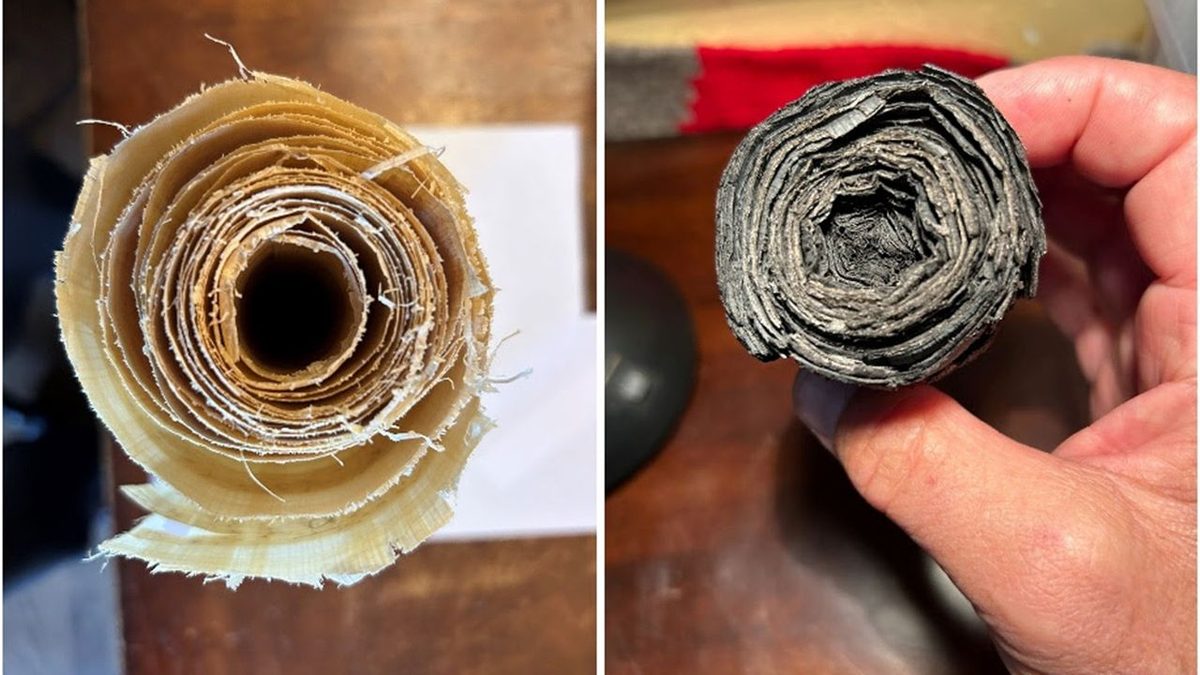
- Simulated Scrolls: The team created modern, carbonized papyrus scrolls using lead-based ink to mimic the conditions of the ancient artifacts, providing a safe testing ground for their technique.
- Promising Results: The method successfully detected and partially deciphered text on the simulated scrolls, even with minuscule amounts of lead present in the ink.
- Low-Risk Approach: This technique allows for the development of text-detection algorithms without endangering the extremely delicate and invaluable original scrolls.
Background
The ancient town of Herculaneum, believed to be owned by Julius Caesar's father-in-law, housed a vast library of papyrus scrolls. When Mount Vesuvius erupted, it buried the town under approximately 70 feet of volcanic ash and rock. This intense heat and pressure carbonized the scrolls, transforming them into charcoal-like objects. While other Herculaneum scrolls have been digitally opened and decoded in recent years, revealing works by Epicurean and Stoic philosophers, the majority remain unreadable due to the challenges posed by the fused and fragile nature of the papyrus and the carbon-based ink.
Previous attempts to read these scrolls often faced a significant hurdle: both the papyrus and the ink were primarily carbon-based, making it difficult for imaging technologies like X-rays to differentiate between them. The breakthrough came with the realization that some of the ink formulations used by the scribes contained lead. This discovery paved the way for a new investigative approach.
Impact Analysis
The implications of this new method are profound. With nearly 2,000 scrolls discovered at the Herculaneum villa, the potential to recover lost ancient literature, philosophy, and historical accounts is immense. The study, authored by Douglas Seiler and colleagues, including researchers from the University of California, Berkeley, provides a tangible pathway to accessing texts that have been hidden for two millennia. The success in deciphering text on simulated scrolls, even with minimal lead content, suggests a high probability of success when applied to the actual artifacts.
“This provides a low-risk method to develop algorithms without endangering the priceless artifacts,” the research team stated in their study.
This low-risk aspect is crucial. The original scrolls are incredibly fragile, and any attempt at physical unrolling or invasive analysis could lead to their complete destruction. The non-destructive nature of X-ray analysis, combined with sophisticated software, offers a safe and effective alternative.
Broader Context
This research fits into a larger, ongoing effort to preserve and understand ancient texts. Advances in imaging technology, computational analysis, and artificial intelligence are revolutionizing archaeology and the study of ancient manuscripts. From deciphering cuneiform tablets to reading faded ink on parchment, these tools are pushing the boundaries of what we can learn from the past. The Herculaneum scrolls represent a unique challenge due to their extreme state of preservation, making this lead-detection technique a significant leap forward in the field of digital paleography.
Future Outlook
The immediate future involves applying this technique to the actual Herculaneum scrolls. Researchers hope to refine the algorithms further to improve the accuracy and completeness of the text recovery. Beyond Herculaneum, the principles of detecting specific elemental compositions in ink could potentially be adapted to read other types of ancient documents or artifacts where traditional methods have failed. The study, published in PLOS One (Seiler et al., 2026), serves as a foundational step, opening a novel path for future investigations into lost knowledge.
Conclusion
The discovery of a method to read text on Vesuvius-charred scrolls marks a significant milestone in our quest to understand the ancient world. By leveraging the presence of lead in ancient ink and employing advanced X-ray technologies and AI, scientists are closer than ever to hearing the voices of those who lived nearly two thousand years ago. This innovative approach not only promises to reveal lost wisdom but also ensures the preservation of these irreplaceable historical treasures for generations to come.
Source: livescience.com