Deep-Sea Searobin Filmed Walking Backwards: A First for Fish Locomotion
Introduction
The deep ocean, a realm of perpetual darkness and immense pressure, continues to surprise scientists with its extraordinary inhabitants. Beyond the well-known oddities like goblin sharks and vampire squid, a recent discovery has added another fascinating creature to the list: a fish that walks backward. For the first time in recorded history, a team of Chinese researchers has captured video evidence of a peculiar, shrimp-like fish propelling itself in reverse along the seabed.
Key Details
- Species Observed: The fish identified is Scalicus engyceros, a species belonging to the armored searobin family.
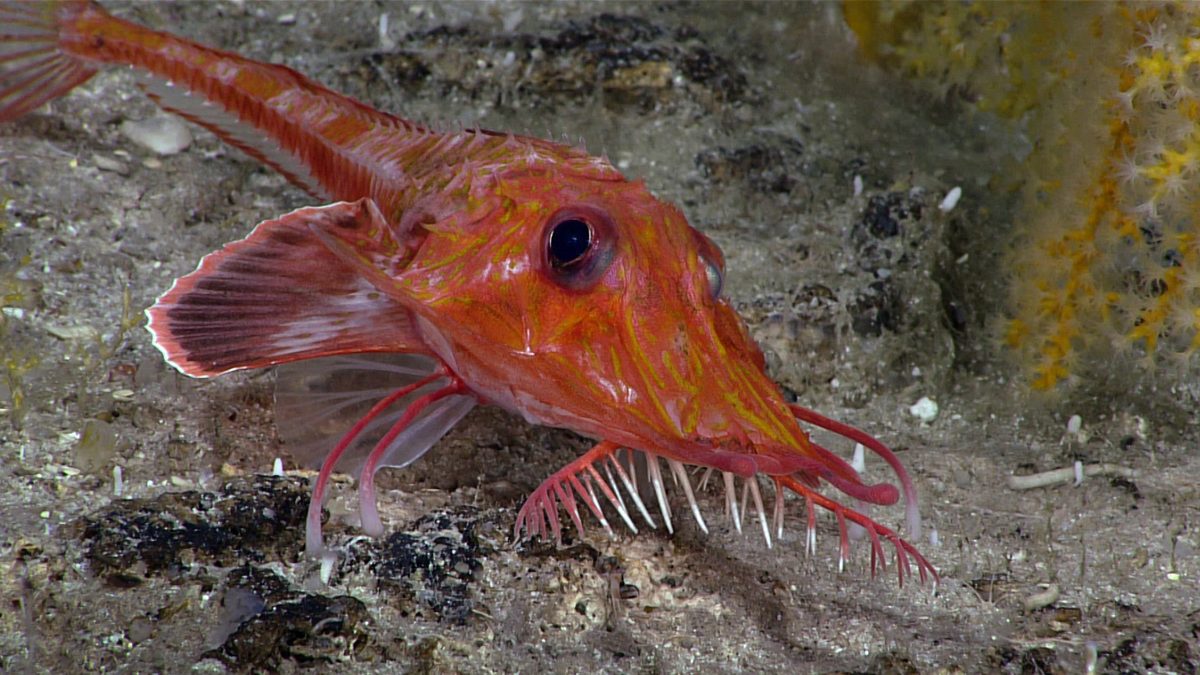
- Unique Locomotion: The study documented the fish walking backward on the seafloor, a behavior previously undescribed in any fish species.
- Anatomical Features: Armored searobins are characterized by their bodies covered in bony plates and possess stiff, free fin rays extending from their pectoral fins, resembling tiny legs used for locomotion.
- Research Publication: The findings were published in the scientific journal Ocean-Land-Atmosphere Research.
- Filming Method: Video footage was obtained using a deep-sea diving vehicle in the northern South China Sea.
- Sensory Organs: The fish exhibits outward-extending barbels, akin to a farmer's rake, which aid in probing, digging, or hunting. It also possesses large eyes, suggesting sensitivity to light.
Background
The armored searobin family (Peristediidae) is known for its unusual morphology. These fish are characterized by a robust exoskeleton of bony plates and a distinct set of modified fin rays. While the ability of some searobins to use their pectoral fin rays to “walk” along the seafloor has been known, the observation of backward locomotion in Scalicus engyceros represents a significant new finding. The study, led by researchers from Sun Yat-sen University in Guangzhou, utilized advanced deep-sea exploration technology to record this behavior in the natural habitat of the fish.
Impact Analysis
This discovery challenges existing paradigms in ichthyology, particularly concerning fish locomotion. The ability to move backward on the seafloor is a novel adaptation that prompts questions about its evolutionary advantage. The researchers hypothesize that this backward movement might be a strategy for navigating complex terrains, avoiding predators, or perhaps a consequence of how the fish utilizes its specialized fin rays. The presence of large eyes, despite living in the deep sea, and the fish's reaction to light suggest it may not be a permanent resident of the absolute deepest zones, or that its visual system is adapted to detect intermittent light sources.
“Our study delivers a paradigm-shifting revelation: the deep-sea fish Scalicus engyceros, a representative of fishes characterized by highly specialized free pectoral-fin rays, is among the few fish species known to walk,” stated Han Tian, a postdoctoral researcher at Sun Yat-sen University.
Broader Context
The deep sea remains one of the least explored frontiers on Earth. Discoveries like this underscore the vast biodiversity hidden within its depths and the unique evolutionary pathways life has taken. The development of sophisticated deep-sea vehicles has been crucial in unlocking these secrets. These technologies allow scientists not only to find new species but also to observe their behavior and ecological interactions in situ, providing a dynamic understanding that complements traditional studies based on preserved specimens.
Future Outlook
The observation of backward walking in Scalicus engyceros opens up new avenues for research. Future studies will likely focus on understanding the precise mechanics of this locomotion, its frequency, and the specific environmental triggers or advantages it confers. Further exploration may reveal whether this behavior is unique to this species or if other related species exhibit similar adaptations. The ongoing advancements in deep-sea technology promise more such revelations, deepening our comprehension of marine life and evolutionary processes in extreme environments.
Conclusion
The video documentation of a deep-sea searobin walking backward is a testament to the ongoing mysteries of the ocean's depths. It highlights the remarkable adaptability of life and the importance of continued exploration. This finding not only adds a curious chapter to the study of fish behavior but also emphasizes how much remains unknown about the ecosystems thriving far beneath the waves, urging further scientific investigation into these enigmatic habitats.
Source: popsci.com