15-Year Quest Yields World's Fairest 60-Sided Dice for Perfect Turn Order
Introduction
For over fifteen years, a persistent question has challenged mathematicians and game designers alike: how to create a set of dice that guarantees a perfectly fair turn order for any number of players in a game, with absolutely no possibility of ties. This quest, initially sparked by a casual dinner conversation, has culminated in a remarkable achievement: a set of five 60-sided dice, meticulously designed to ensure absolute fairness. This breakthrough not only solves the long-standing “go first dice” problem but also reveals a deeper level of probabilistic fairness, ensuring that not only the first player is determined equitably, but the entire sequence of play is equally likely for any permutation of players.
Key Details
- A set of five 60-sided dice has been developed to ensure a perfectly fair turn order for any number of players.
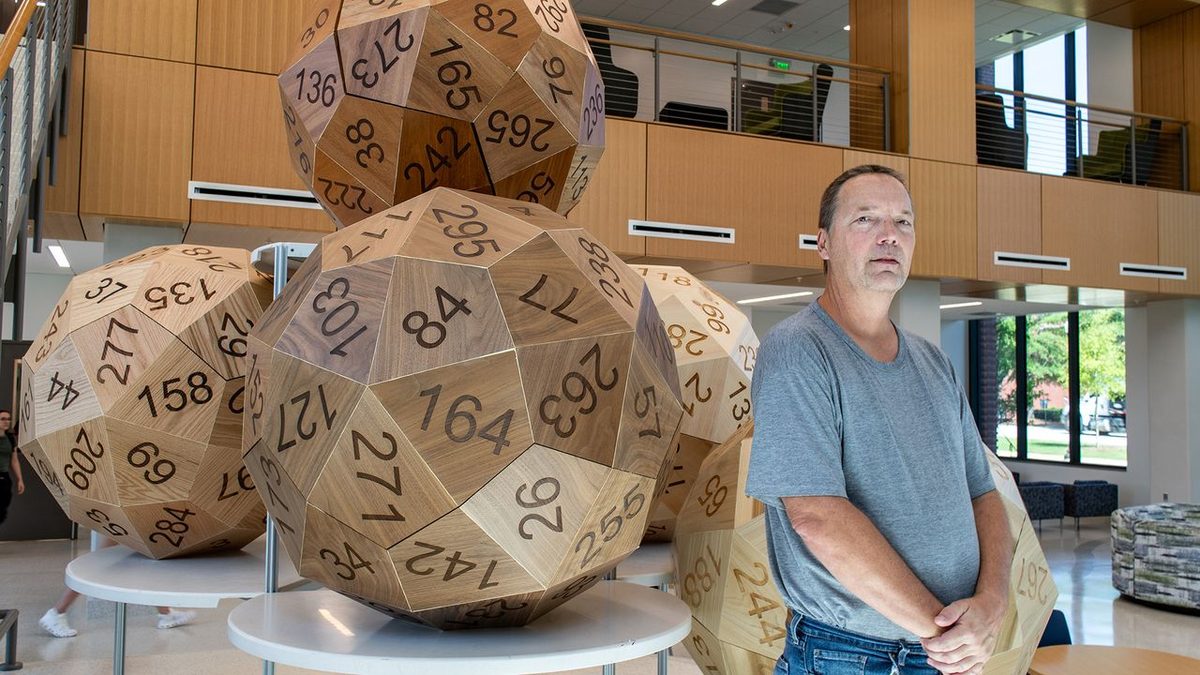
- The dice are engraved with numbers ranging from 1 to 300, with no repeats.
- The design guarantees zero chance of ties and no need for rerolls.
- Beyond determining the first player, the dice ensure “permutation fairness,” meaning every possible order of players is equally likely.
- The solution was found by mathematicians Eric Harshbarger and Robert Ford, with a crucial contribution from software engineer Paul Meyer.
- Giant wooden replicas of these dice are now on display at Auburn University's new mathematics building.
Background
The problem originated around 2010 when board game designer James Ernest posed a question to his friend, mathematician Eric Harshbarger: could a set of dice be designed such that any player, regardless of the group size, could roll and have an equal chance of going first? The core challenge lay not just in assigning unique numbers to the dice, but in distributing them across the faces of multiple dice in a way that maintained fairness for any subset of players who might choose dice from the set. This meant the fairness had to hold whether two people were playing or ten, and no matter which specific dice each person happened to pick.
Harshbarger, then at Auburn University, initially lacked an answer. The problem, which became known as the “go first dice” problem, occupied him and a network of collaborators for the next 15 years. Early progress was made by Harshbarger and his childhood friend Robert Ford, a mathematician at Dalton State College. They developed a solution for three players using three 6-sided dice and later, Ford devised a four-player solution using four 12-sided dice, a feat accomplished entirely by hand. Harshbarger began selling handmade sets of these four-player dice, gaining wider attention, including coverage by The Guardian.
Impact Analysis
The significance of this solution extends beyond mere game mechanics. The dice don't just determine who goes first; they ensure that every possible sequence of players is equally probable. This property, termed “permutation fairness,” adds a profound layer of impartiality. For instance, in a four-player game, the likelihood of players finishing in the order A, B, C, D is precisely the same as any other sequence, such as C, B, D, A. This level of fairness is exceptionally difficult to achieve with conventional dice and probability.
The mathematical complexity involved in finding a solution for five players was immense. The search space for possible number arrangements was astronomically large—estimated to be around 10 to the 128th power, far exceeding the number of atoms in the observable universe. Brute-force computation was impossible, necessitating the discovery of sophisticated mathematical shortcuts, symmetries, and patterns to narrow down the possibilities. Even with these optimizations, the search proved arduous, with many potential solutions involving dice with an impractical number of sides, making them impossible to manufacture or handle.
“My goal was a set for five players that can actually be manufactured, that you can hold in your hand, that board gamers could buy and roll... You can't do that with 180-sided dice.”
Broader Context
The development of these dice sits within a rich history of mathematical exploration in games and probability. From ancient games of chance to modern computational mathematics, the pursuit of fairness and unpredictability has been a constant theme. This particular problem highlights the intersection of abstract mathematical theory and practical application, demonstrating how complex theoretical challenges can yield tangible, albeit niche, innovations. The journey of the “go first dice” problem also reflects the collaborative nature of modern scientific discovery, where insights from different individuals, like software engineer Paul Meyer, can unlock solutions that have eluded teams for years.
Meyer’s contribution in mid-2023 was pivotal. By analyzing patterns in Harshbarger's earlier four-player data and developing a specialized program, he was able to identify a viable configuration for five players. This solution utilized 60-sided dice, a size that, while large, was deemed manufacturable and practical for use in games. Harshbarger confirmed Meyer’s findings, marking the end of a 15-year search.
Future Outlook
With the five-player solution now established and proven manufacturable, the potential for these dice to be adopted in the gaming community is significant. While the initial problem was focused on determining turn order, the underlying mathematical principles could inspire further research into fair game design and probability. The creation of giant, sculptural replicas of the dice serves a dual purpose: as a testament to the mathematical achievement and as an educational tool, aiming to make complex mathematics accessible and engaging to the public. The hope is that such visible representations of mathematical concepts will spark curiosity and appreciation for the field.
Conclusion
The successful design of the five 60-sided dice represents a triumph of mathematical persistence and ingenuity. What began as a simple question about fair game mechanics evolved into a complex, multi-year research project. The solution not only provides a definitive answer to the “go first dice” problem, ensuring perfect fairness and permutation fairness for any number of players, but also demonstrates the power of collaboration and innovative problem-solving. The tangible outcome—a set of dice that are both mathematically elegant and practically achievable—along with their artistic display, underscores the beauty and accessibility of mathematics.
Source: livescience.com